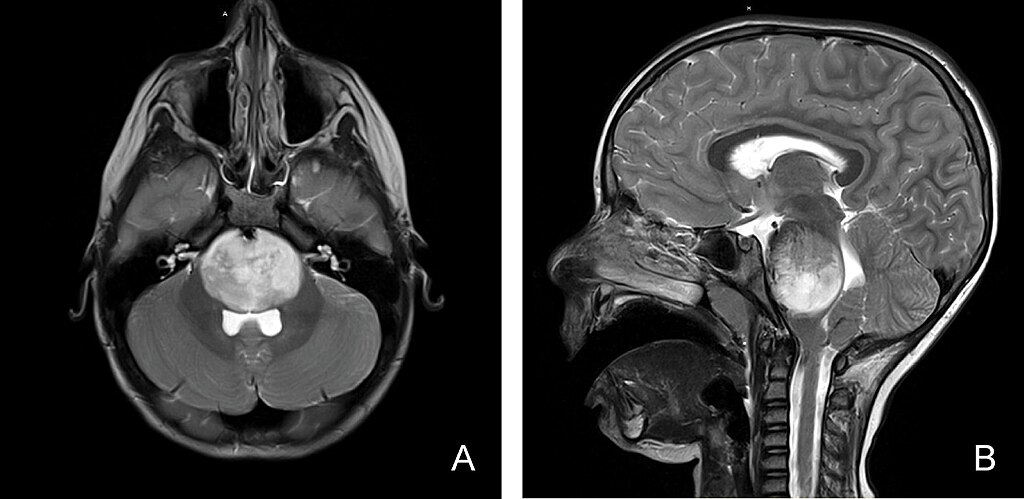
Vasogenic edema
Vasogenic edema is a buildup of fluid in the brain due to a disruption in the blood brain barrier (BBB). The BBB is a network of blood vessels and tissue that helps keep harmful substances from reaching the brain.
Normal pressure hydrocephalus
Normal pressure hydrocephalus (NPH) is a condition that is caused by an abnormal buildup of cerebrospinal fluid (CSF) in the ventricles (cavities or spaces) of the brain without an increase in intracranial pressure. Cerebrospinal fluid is a clear liquid that circulates around the brain and spinal cord, cushioning and protecting them from damage. With NPH, an excess of cerebrospinal fluid is present because the body cannot properly drain and absorb the fluid. The differences between NPH and other forms of hydrocephalus is that even though there is a larger than normal amount of CSF, the pressure inside the ventricles remains the same.
Normal pressure hydrocephalus most often occurs in people over age 60. The exact cause of normal pressure hydrocephalus (NPH) is not clear. However, in some cases, NPH can occur as a result of other conditions such as bleeding around the brain from head injuries/stroke or infections such as meningitis.
Old infarct
An infarct (short for infarction) is a stroke caused by an interruption of a healthy blood supply to the brain. Old infarcts are not reversible. They are most commonly caused by the same risk factors that cause heart disease, including high blood pressure, poor cholesterol levels, diabetes, smoking and sometimes emboli (small particles such as blood clots or plaque that traveled from other parts of the body).
Pericallosal lipoma
Pericallosal lipomas are fat-containing lesions occurring in the interhemispheric fissure (the deep groove that separates the left and right sides of the brain) closely related to the corpus callosum. It is the most common location for an intracranial lipoma. Curvilinear pericallosal lipomas are usually thin, elongated and curvilinear along the corpus callosum margin.
Partial agenesis and hypoplasia of the corpus callosum with a curvilinear pericallosal lipoma
The corpus callosum is a large, C-shaped nerve fiber bundle found beneath the cerebral cortex (the wrinkly outermost layer of the brain which is responsible for thinking and processing information from the five senses). It stretches across the midline of the brain, connecting the left and right sides, and makes up the largest collection of white matter tissue (the brain tissue that contains nerve fibers and serves as the connection point to other parts of the brain) found in the brain.
Developmental abnormalities or disorders of the corpus callosum include complete agenesis (absence), partial agenesis (hypogenesis), thinning (hypoplasia), or thickening (hyperplasia). In partial agenesis, the corpus callosum is shorter in its anterior-posterior length as a result of missing segment(s). In hypoplasia, the corpus callosum is normal in its anterior-posterior length, but there is thinning. In hyperplasia, the corpus callosum is thicker than expected.
Partial empty sella appearance
Partial empty sella appearanceThe pituitary gland is a small gland that sits in the sella turcica, a saddle-shaped depression located in the bone at the base of the skull. It produces hormones that control different processes in the body, including metabolism, growth and reproduction. “Empty sella” is a radiologic description and not a clinical condition - the sella turcica is either partially filled with cerebrospinal fluid and a very small pituitary gland (partially empty sella), or completely filled with cerebrospinal fluid with no visualized pituitary gland (completely empty sella).
Empty sella syndrome may occur as a primary disorder, from an unknown cause, or as a secondary disorder, from an underlying condition such as a treated pituitary tumor, head trauma, or elevated intracranial pressure. In empty sella syndrome, the pituitary gland is usually functioning normally. In empty sella syndrome, the pituitary gland is usually functioning normally, so most individuals do not have any symptoms.